Showing posts with label New York. Show all posts

Saturday, September 18, 2010

Karma Triyana Dharmachakra

One brisk early Autumn day some years back, I set out for Karma Triyana Dharmachakra, nestled in the Catskill Mountains near Woodstock, New York. I was living in Ithaca, New York at the time and it made for a great morning road trip.

As the seat of the Karmapa (the head of the Karma Kagyu school of Tibetan Buddhism) in the West, Karma Triyana Dharmachakra's history, presence (spiritual and physical) and dynamic schedule has served as a significant hub in the gradually expanding network of Vajrayana centers since the 1970's.

Many temples and Buddhist centers are set within a range of rich, meditative landscapes. KTD's surroundings are expansive, rolling and woodsy. As excited as I was to reach KTD, the journey there was an event in itself.

Inside shrine room

Photos by Annika Lundkvist

KTD was founded in the 1970's and construction of representative architecture here in the 1980's.

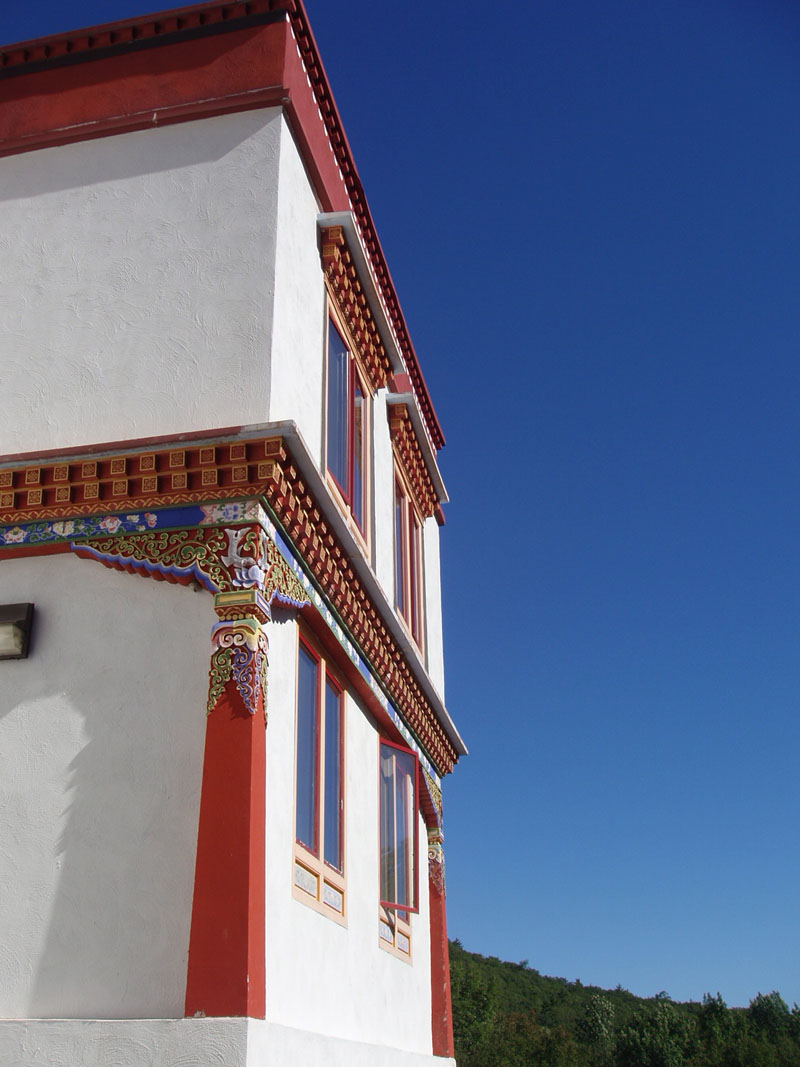


Mead's Mountain House, part of the KTD complex, was built in 1865, functioned for a period of time, historically, as a summer hotel.

When I visited, construction for the monastery was underway. Taking a look at their website, the news is that the monastery is complete.


Wednesday, June 23, 2010

A Kagyu Landmark in NY State


Source for all images:

Source: Kagyu Thubten Chöling Monastery website


Founded in 1978 by Lama Norlha Rinpoche, just a couple of years after his arrival in the States Kagyu Thubten Chöling Monastery is located in Wappinger Falls, New York.

The first dharma center in North America to offer a traditional three year retreat for serious and dedicated students to train in the Kagyu lineage, Kagyu Thubten Chöling is one of the oldest dharma centers in North America and certainly among the very first Tibetan Buddhist monasteries to be established on the continent.

The center also serves as mother Monastery to:
Kagyu Drupgyu Chödzong (D.C.)
Kagyu Shenpen Tharchin (VA)
Kagyu Puntsok Gatsal Chöling (VA)
Kagyu Samchen Chöling Dharma Center (VA)
Kagyu Gyurmey Gatsal Chöling (Key West, FL)
Kagyu Tashi Chödzong (Coconut Grove, FL)
Kagyu Shedrup Chöling (El Portal, FL)
Kagyu Trinley Kunchab (Watertown, MA)
Kagyu Osel Chödzong (NH)
Kagyu Samten Chöling (Barrington, NH)
Kagyu Osel Chöling (Westfield, NJ)
Kagyu Dakshang Chöling (NYC, NY)
Kagyu Dzamling Kunchab (NYC, NY)
Kagyu Pende Kunchab (Red Hook, NY)
Kagyu Samdrup Chödzong (Greensboro, NC)
Milarepa Drakmar Kyung Dzong (Arden, NC)
Milarepa Osal Chö Dzong (Tallahassee, TN)
Kagyu Palchen Chöling (Montpelier, VT)
Kagyu Tarjay Chöling (Lima, Peru)
Kagyu Drupgyu Chöling (Cusco, Peru)
Kagyu Gempel Chöling (Quebec, Canada)


Source: Kagyu Thubten Chöling Monastery website


Thursday, May 27, 2010

The Universality of Primary Hues

One of the first things that captured me about the Tibetan Buddhist design tradition was the color scheme. It originally struck me, and still does, as elementary. Elementary in that best sense of the word, straightforward and universal.

If you have ever seen a Tibetan prayer flag rippling in the wind, you should recall the bright spread of primary colors. The same scheme is integrated in Tibetan Buddhist temple and building design worldwide, both exteriorly (when possible) and interiorly.

White relates to the element of Space/all encompassing space/buddha

Green relates to the element of Wind/all encompassing wisdom/karma

Red relates to the element of Fire/discriminating awareness wisdom/padma

Blue relates to the element of Water/mirror like wisdom/vajra

Yellow relates to the element of Earth/wisdom of equanimity/ratna


The above photo of Kagyu Shenpen Tharchin in Richmond, Virginia is, in my opinion, a quite humble and pretty example of a small sangha's ceremonial and practice space, with a prominent interior use of the yellow and red hues. Why wood floors seem to be always be most fitting, atmospherically, aesthetically and even, religiously, in spiritual centers is a question that seems simple to me but which I haven't got the answer to yet.

Established in 1993, the center is, to date, the only Tibetan Buddhist centre in Richmond, Virginia. The center is part of Ekoji Buddhist Sangha which is host to other sanghas of Buddhist tradition: a Vipassana group, a Zen group and a Pure Land Group. This truly makes Ekoji a multi-dimensional center, to serve as host to different Buddhist traditions as well as be encouragingly open door to those who do not claim a lineage, tradition or faith.

The Tibetan Buddhist sangha at Ekoji, Kagyu Shenpen Tharchin, was established through the efforts of Lama Norlha, the founder of Kagyu Thubten Chöling Monastery in upstate New York. The story of many Tibetan Buddhist leaders journeys, particularly in the latter half of the 20th century, is layered with several different geographies and, of course, the story of cultures adapting to religious tradition, or perhaps, more critically, vice versa. Diamond Vehicle is a film in the works about Lama Norlha, that appears to have captured all of this, along with the political backdrop that has served as the catalyst for the perhaps, unexpected, yet completely global reading and interest in the Vajrayana.